Article focus
middle school students speak up safely
This article is written for principals, counselors, teachers, school safety teams, and other staff planning proactive middle or high school safety education.
Why speaking up feels harder in middle school
Middle school is a strange social territory. Students are old enough to understand that words and actions can have serious consequences, but they are still learning how friendship, loyalty, reputation, and responsibility fit together. A sixth grader may know that a classmate's comment feels wrong and still hesitate because the strongest social rule in the hallway is often 'do not be a snitch.' That hesitation is exactly why a middle school safety assembly needs more than a slogan. Students need language that helps them understand when speaking up is an act of protection rather than betrayal.
The first step is to lower the emotional cost of reporting. Instead of telling students to report every unusual thing they see, schools can teach them how to notice patterns, context, and urgency. A student does not need to investigate or prove a concern. They only need enough awareness to say, 'Something about this worries me and I think an adult should know.' That is the beginning of Be Aware. Be Brave. Be Heard. It gives students permission to notice without demanding that they solve the problem themselves.
Teach the difference between tattling and protecting
One of the most useful conversations a middle school can have is the difference between tattling and reporting. Tattling is usually about getting someone in trouble over a small conflict or rule violation. Reporting is about getting help because someone could be hurt, threatened, harassed, bullied, or placed in an unsafe situation. Students understand that distinction when adults explain it with examples instead of just definitions. A disagreement over a seat is different from repeated intimidation. A silly joke is different from a threat that keeps escalating. A private rumor is different from a post that suggests someone may be in danger.
The language should stay simple enough to remember in a stressful moment. A student can begin with, 'Can I tell you something that is worrying me?' or 'I saw something and I do not know how serious it is.' Those sentences are powerful because they do not require the student to make an accusation. They invite an adult into the decision. In an interactive school safety assembly, practicing that first sentence can be more valuable than giving students a long list of policies they will never remember.
Give every student more than one trusted adult
Schools sometimes assume students already know who their trusted adults are. Many do not. A counselor may feel obvious to staff but intimidating to a student who has never visited the office. A principal may be highly approachable but still feel distant to a seventh grader. The practical goal is for every student to identify at least two adults they would realistically approach. Those adults might be teachers, coaches, counselors, administrators, school resource officers where applicable, or another staff member the school has designated as part of its reporting process.
Two adults matter because availability matters. The first person may be absent, busy, or not the right person for the issue. Students should hear that if the first attempt does not feel complete, they can tell another trusted adult. Being heard is not about repeating rumors until someone agrees; it is about making sure a legitimate concern reaches a person who can respond. That idea fits naturally with Be Heard, because it moves the message beyond 'say something' and into 'make sure the right person receives useful information.'
Use interaction so the safety lesson does not feel like a lecture
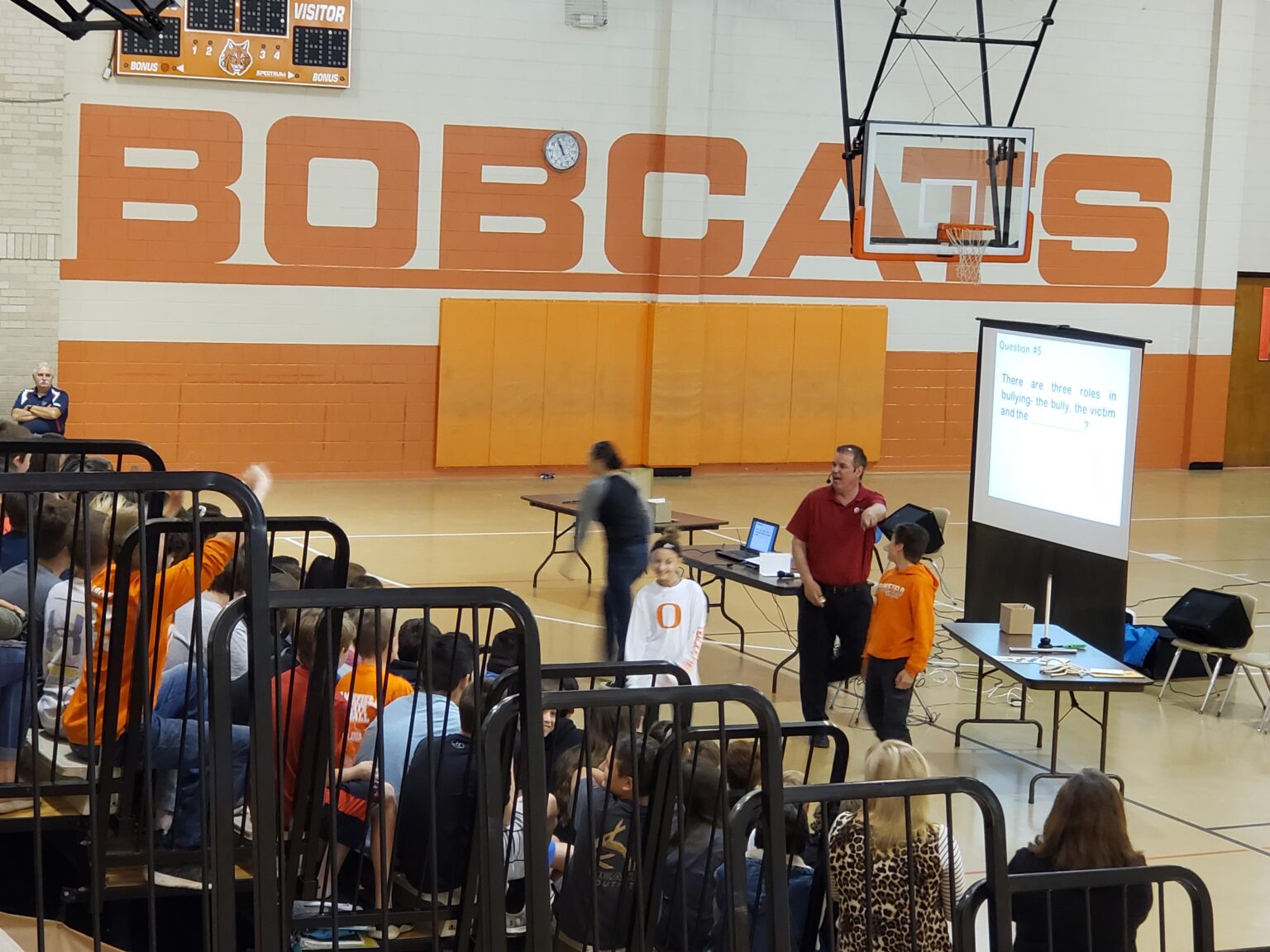
Middle school students can sit through a serious presentation, but attention is easier to earn when the room is involved. Magic, audience participation, short videos, and follow-up quizzes can make a school safety assembly more memorable without making light of the topic. A magic routine can demonstrate how easy it is to miss an important detail. A volunteer exercise can show how information changes as it passes from person to person. A short video can create a natural transition from humor to a serious point about online behavior or warning signs.
The important rule is that the interactive element must serve the lesson. Students should be able to explain why the activity mattered after the laughter stops. That is where good presentation design helps. The entertainment earns attention, but the message gives that attention somewhere useful to go. For grades 6-8, the strongest takeaway is often not a complicated safety protocol. It is a confident three-step memory: Be Aware of what feels wrong, Be Brave enough to get help, and Be Heard by a trusted adult.
What schools should do after the assembly
A strong middle school safety assembly should begin a conversation, not end one. In the days after the presentation, advisory teachers can ask students to name one warning sign, one trusted adult, and one safe reporting step. Counselors can reinforce how confidential concerns are handled within the limits of school policy. Posters or digital reminders can repeat Be Aware. Be Brave. Be Heard. without adding new language. A short follow-up quiz gives staff a simple way to see whether students remember the reporting path.
The most important follow-up is adult behavior. When a student speaks up, the response should be calm, respectful, and as discreet as the situation allows. Students notice whether reporting creates unnecessary drama. They also notice whether adults take concerns seriously. If the experience is handled well, one student's decision to speak up can quietly teach an entire peer group that the system works. That is how a one-time assembly begins to support a safer school culture rather than becoming another event on the calendar.
The goal is confidence, not fear
Middle school safety education works best when students leave feeling capable. Fear can get attention for a moment, but confidence gives students a next step. A student who understands what to notice, who to tell, and how to begin the conversation is more prepared than a student who simply leaves worried. That is why proactive school safety should focus on awareness, courage, communication, and trust instead of graphic examples or worst-case scenarios.
For schools planning a middle school safety assembly, the central question is simple: what do we want a student to do tomorrow if something concerns them? If the answer is clear, the presentation can be built around that behavior. Jim Jordan's Be Aware. Be Brave. Be Heard. framework is designed to make that behavior easy to remember, while the larger See Something Say Something idea reinforces why speaking up matters. Schools can review the full program or their state page to see how the same message is adapted for grades 6-8 and grades 9-12.